
Integrating global HR software with Swiss payroll services requires more than synchronising employee records. International organisations need a reliable way to transfer approved HR changes while ensuring that Swiss salary calculations, employment responsibilities and statutory reporting are handled correctly. The practical approach is to maintain consistent employee information centrally, configure payroll for Swiss requirements and validate every important exchange before implementation.
How global HR software works with Swiss payroll
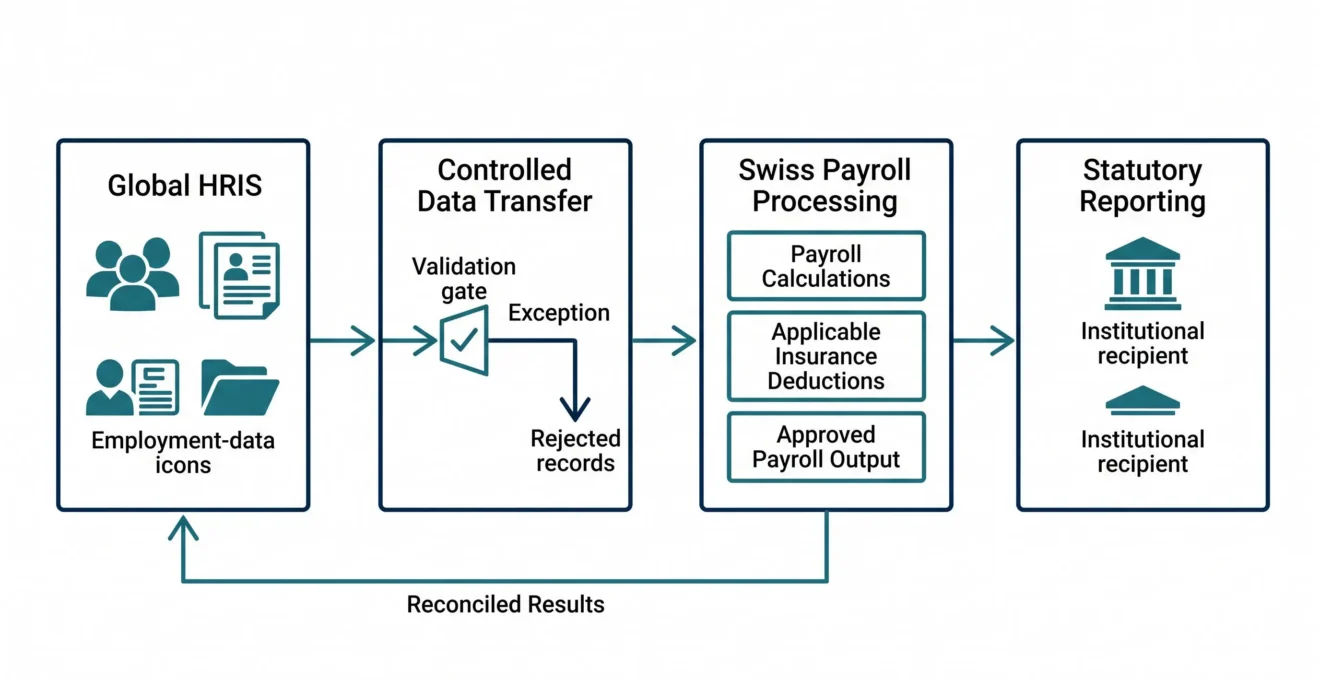
A global human resources information system (HRIS) typically maintains employee profiles, employment dates, organisational structures, contractual information and approved changes. Swiss payroll processing uses relevant employee information to calculate salaries, apply applicable deductions and prepare payroll-related reporting.
These functions are complementary rather than interchangeable. An employee record can be complete at group level but still lack information required for Swiss payroll, such as insurance classifications, pension arrangements, work-location details, withholding-tax information or other employment-specific attributes.
Organisations should therefore establish which system owns each field, who approves changes and which information must be transferred. The global HRIS can remain the principal source of employee records while the local payroll process handles jurisdiction-specific calculations and checks.
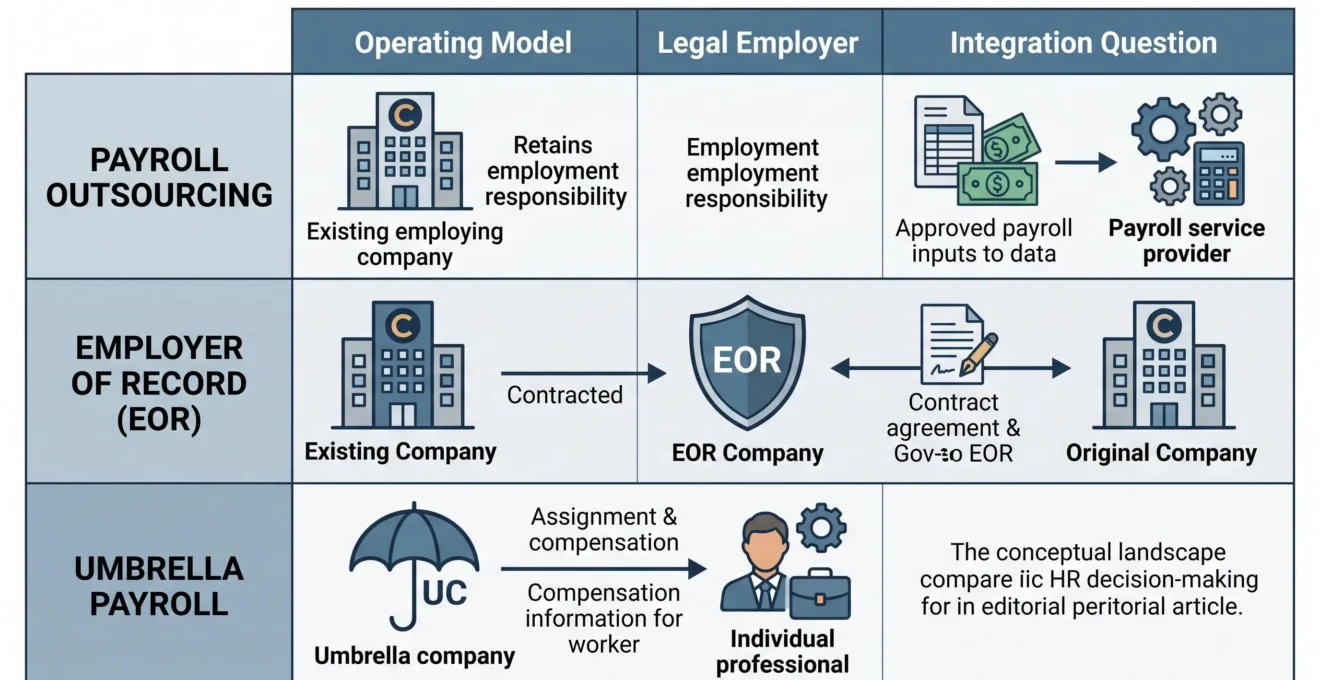
The employment arrangement must also be clear before the integration is designed. With payroll outsourcing, the existing company remains the employer and delegates salary administration. Under an employer-of-record arrangement, the contracted employer employs the worker under the applicable agreement. In an umbrella arrangement, the umbrella company employs the individual under its own contractual structure. The resulting responsibilities and data flows are not identical.
When an international company needs Swiss payroll administration, it should first identify whether it intends to retain its existing employment relationship or use a separate employment arrangement. Numeriq describes several payroll services in Switzerland, including payroll administration for existing employers and separate employer-of-record and umbrella arrangements. Comparing these models helps HR teams identify which employment responsibilities and payroll processes must be coordinated before transferring employee information.
Build a reliable HR-to-payroll data flow
The integration process begins with employee-data ownership. Each payroll-relevant field needs a defined source, destination, format and validation rule. An approved salary change, for example, should identify the employee, the revised amount, the currency and the effective date.
Information can move through a supported connector, an application programming interface (API) or a controlled file exchange. The appropriate method depends on the systems involved and the capabilities actually supported by the organisations and providers. An API is not automatically more reliable than a properly validated file transfer: both need access controls, error handling and reconciliation.
Before activating the exchange, HR and payroll teams should agree on how changes are authorised, when records are transmitted and how exceptions are assigned. The following sequence provides a practical implementation framework.
- Maintain approved employee master data in the global HRIS.
- Collect validated compensation, absence and employment changes.
- Transmit only the necessary information through an agreed interface.
- Check Swiss payroll calculations and resolve rejected changes.
- Reconcile payroll outcomes and return authorised results to the relevant HR records.
Effective dates deserve particular attention. A salary adjustment approved in October but effective in September may require a different treatment from a change taking effect in November. The receiving payroll process must identify the correct period and determine whether a retrospective correction is needed.
Exception handling is equally important. A missing insurance classification, duplicate employee identifier or invalid effective date should generate a visible issue for an authorised person to resolve. Silently accepting an incomplete record can create discrepancies that are only discovered after payroll has been processed.
Apply Swiss payroll and reporting requirements
Swiss payroll requires more than a basic gross-to-net calculation. Depending on the employee’s circumstances, the payroll configuration may need to account for old-age and survivors’ insurance (AVS/AHV), disability insurance, income compensation, unemployment insurance, occupational pensions, accident insurance and withholding tax.
These components do not all operate as identical employee deductions. For example, contributions to the Swiss OASI, DI and income-compensation system are generally shared equally between employer and employee. Other insurance premiums and pension contributions follow their own applicable arrangements. The treatment of withholding tax also depends on the employee’s circumstances.
Consequently, HR teams should distinguish employee deductions from employer costs and maintain the payroll attributes needed to calculate each component correctly. The Swiss OASI/DI Information Centre publishes an annual contribution-rate reference, including its 2026 table, which illustrates why payroll configuration must use the applicable period rather than an assumed universal percentage. A single gross-to-net conversion rate cannot reliably represent every employee’s situation.
The distinction between payroll calculation and statutory reporting is equally important. Transferring approved employee changes from a global HRIS into a Swiss payroll application is not the same operation as transmitting salary declarations to Swiss institutions.
The Swiss Confederation explains how unified Swiss payroll reporting uses Swissdec-certified salary accounting software to transmit relevant payroll information to participating social insurance agencies and authorities. This reporting process concerns the payroll application’s communication with designated recipients, not the initial HRIS-to-payroll connection.
Technical evaluation should also distinguish connectivity from the Swiss payroll data standard. Swissdec’s ELM version 6.0 documentation, issued on 6 March 2026, is the current certification basis identified on its standards page. The actual payroll application’s implementation and certification status must still be established separately.
For an international HR team, the practical implication is straightforward: confirm the local payroll configuration and reporting capability independently of the global HR platform’s ability to exchange employee information. A working interface does not establish that the receiving payroll application is certified for the reporting process required.
Protect employee data across borders
International HR integration involves personal information that may be accessible to several departments, service providers or group companies. The architecture should therefore establish which information each recipient needs, why access is justified and how the information is protected throughout its lifecycle.
Swiss employee-data guidance from the Federal Data Protection and Information Commissioner explains that employers must process personnel information proportionately to the employment purpose. Appropriate access restrictions, clear responsibilities and retention arrangements help prevent employee records from being used more broadly than necessary.
Practical safeguards include role-based permissions, protected data transmission, recorded changes, controlled retention and clear procedures for correcting inaccurate records. Payroll personnel may need bank-payment details or insurance attributes that are unnecessary for other HR users.
Cross-border access check: A Swiss employee record may become accessible outside Switzerland when a foreign group company, cloud provider or outsourced processor can access it. Identify the countries involved, the recipient organisations and the safeguards governing the disclosure. The location of the payroll operator alone does not establish where employee data can be accessed or processed.
The employer does not automatically transfer its data-protection responsibilities when it appoints a processor. The FDPIC explains that the organisation must select the processor carefully, provide appropriate instructions and monitor compliance where necessary. It must also examine whether an international disclosure has an appropriate legal basis and adequate protection. Depending on the destination and arrangement, this may require an adequacy assessment or suitable contractual safeguards.
Remote access also needs to be assessed in context. The FDPIC distinguishes an employee accessing the employer’s Swiss server securely from abroad without making the data accessible to anyone else from a disclosure to a foreign recipient. These situations should not be treated as automatically equivalent. Provider changes, new cloud services and additional subcontractors therefore deserve a fresh review of access, processing locations and responsibilities.
Choose and test an integration model
Choosing an operating model begins with the employment relationship. The relevant questions are who employs the staff, who processes payroll and who approves information exchanged between systems. The comparison below helps separate these responsibilities before a technical implementation is selected.
| Model | Legal employer | Key integration question |
|---|---|---|
| Payroll outsourcing | The existing employing company | How will approved HR changes reach the payroll processor? |
| Employer of record | The contracted EOR, subject to the actual arrangement | Who maintains employee records and approves changes? |
| Umbrella payroll | The umbrella employer under its employment arrangement | How will assignment and compensation data be communicated? |
After identifying the appropriate employment model, request a demonstration of the actual integration process. Confirm the systems supported, available data fields, transfer frequency, approval stages, correction handling, reporting responsibilities and procedure for resolving failed exchanges. A general promise of compatibility is less useful than seeing how a representative employee change is processed.
A controlled test should include routine and exceptional scenarios. Successful onboarding alone does not establish reliability if departures, retrospective salary corrections or changes to insurance information remain untested.
- Confirm employee identifiers, payroll fields and effective dates.
- Test starters, leavers, salary changes and absence scenarios.
- Reconcile deductions, approved net pay and corrections.
- Verify reporting responsibilities and transmission status.
- Assign access permissions, exception owners and approval rules.
Each test should have a documented expected result. Differences from the approved payroll reference must be explained or corrected, rejected records must have an assigned owner, and unresolved discrepancies must be closed before production approval. This is an operational acceptance approach, not a universal numerical success threshold.
After deployment, monitor rejected records, unresolved discrepancies, payroll corrections and reporting completion. These indicators help identify whether the integration remains reliable as employee records and payroll requirements change.
A practical starting point
Integrating global HR software with Swiss payroll works best when employee-data ownership, employment responsibilities and local reporting requirements are defined before technical implementation. Start by mapping the existing HR records and identifying which fields the Swiss payroll process requires. Then agree on the transfer method, test realistic employee changes and reconcile the resulting calculations and declarations against approved records.
Centralising approved employee information can reduce repeated data entry, while local payroll validation, statutory reporting and exception handling remain essential. The objective is not to remove every control, but to make international HR administration more consistent without losing oversight of Swiss payroll responsibilities.