Every roofing contractor knows the sinking feeling that follows a preventable error. Material waste, timeline extensions, and client frustration compound into financial losses that far exceed the cost of the mistake itself. Yet the industry conversation around tool quality rarely moves beyond surface-level advice about buying premium brands or maintaining equipment properly.
The reality operates at a deeper level. Tool quality decisions trigger cascade mechanisms that either protect or erode project profitability through channels most contractors never quantify. Understanding the roofing tools you deploy as risk-prevention instruments rather than simple implements transforms how you evaluate their true return on investment.
This framework shift matters because the financial consequences of inadequate equipment follow exponential rather than linear patterns. A single measurement tool inaccuracy doesn’t just waste one bundle of shingles. It initiates a sequence of material reorders, weather window misses, schedule compressions, and safety compromises that can multiply initial costs by factors of five to ten.
The following analysis reveals the hidden mechanisms, cost multipliers, and diagnostic patterns that separate strategic tool investment from reactive purchasing. By mapping these relationships, contractors gain a prevention-focused methodology that prioritizes equipment upgrades based on expected value rather than subjective preferences.
Quality Tool Investment: The Prevention Framework
- Tool failures cascade through sequential project phases, creating timeline compression that forces error-prone rushed work
- Hidden costs from equipment inadequacy exceed direct material waste by 5-10x through permit extensions and opportunity losses
- Client perception of equipment quality directly impacts referral velocity and lifetime relationship value
- Diagnostic patterns distinguish tool-driven defects from skill issues, preventing costly misattribution
- Risk-mapping frameworks prioritize investments by failure consequence severity rather than purchase price alone
How Single Tool Failures Cascade Into Multi-Phase Project Delays
The roofing industry faces unprecedented cost pressures. Recent analysis shows that roof claims reached over $31 billion in 2024, representing a 30% increase since 2022. While weather events drive much of this expense, the underlying vulnerability often traces back to equipment inadequacy during initial installation or repair phases.
Tool failures rarely announce themselves as isolated incidents. Instead, they initiate dependency chains where each compromised step constrains the next. A laser level that drifts by half a degree produces cutting errors across multiple material bundles. Those errors trigger reorder delays that push work into weather windows with lower probability of completion. Compressed timelines then force crews to accelerate pace beyond safe or quality-preserving thresholds.
Timeline Extension Analysis from Hidden Damage Discovery
Research shows that unexpected structural damage discovery extends project timelines by 40-60%, with inspection delays adding 2-5 days and material reorders creating additional week-long gaps in high-demand seasons. These extensions don’t simply delay completion. They compress the remaining work phases, creating productivity paradoxes where crews attempting to recover lost time actually increase error rates through rushed execution.
The impact varies by material complexity. Simple asphalt shingle installations tolerate tighter timelines, while metal panel and concrete tile projects require precision that deteriorates rapidly under schedule pressure.
| Material Type | Standard Timeline | With Delays |
|---|---|---|
| Asphalt Shingles | 1-3 days | 5-7 days |
| Metal Panels | 7-14 days | 21+ days |
| Concrete Tiles | 8-12 days | 18-24 days |
Multi-trade coordination represents another cascade vulnerability. When roofing delays push into windows reserved for HVAC installation or gutter work, the ripple effect creates liability exposure across multiple contractor relationships. Subcontractors who miss their scheduled slots often can’t return for weeks, further extending project completion and multiplying client dissatisfaction.
Critical Timeline Compression Prevention Steps
- Conduct detailed pre-project moisture scanning to identify hidden damage zones
- Build 20% timeline buffer for weather and inspection contingencies
- Secure backup material suppliers to prevent reorder delays
- Implement project management software for real-time schedule tracking
The prevention strategy focuses on eliminating the initial trigger rather than managing downstream consequences. Quality measurement tools, reliable fastening equipment, and properly calibrated cutting implements prevent the first domino from falling. This upstream intervention delivers returns that compound across every subsequent project phase.
How Equipment Failures Generate Hidden and Exponential Cost Multipliers
Direct costs capture immediate attention. Wasted materials appear in inventory loss. Redo labor shows up in crew hour overruns. But these visible expenses form only the base layer of a cost pyramid that extends far beyond the initial mistake.
Insurance industry data reveals the structural dimension of quality gaps. Analysis demonstrates that roofs with moderate to poor conditions have 60 percent higher loss costs compared to structures maintained with proper standards. This differential reflects not just material degradation but the compounding consequences of substandard execution driven by inadequate tooling.
The second tier of costs operates semi-hidden. Permit extensions required when projects exceed authorized timelines generate fees that don’t appear in material budgets. Equipment rental periods that stretch beyond projections create daily charges that accumulate silently. These indirect expenses frequently match or exceed the direct material waste that triggered them.

The apex of the cost pyramid contains the most damaging element: opportunity cost. Every day spent correcting equipment-driven errors represents a day unavailable for new project bidding or execution. During peak seasons when demand exceeds contractor capacity, these lost opportunities carry profit margins far higher than the correction work consumes.
Material and labor costs continue their upward trajectory, making each mistake more expensive over time. Understanding these trends helps quantify the true cost of quality gaps.
| Year | Material Cost Increase | Labor Rate Change |
|---|---|---|
| 2023 | +4-5% | +3.5% |
| 2024 | +2-3% | +4% |
| 2025 (Projected) | +3-4% | +3-5% |
Seemingly small adjustments, such as dimension or material changes can substantially alter the timeline and costs associated with a project
– SFS Industry Report, Commercial Roofing Industry Updates 2024
Reputation erosion operates as the longest-duration cost multiplier. Digital review platforms and contractor referral networks mean that quality issues documented during one project influence bidding power and pricing flexibility for years afterward. A contractor known for callbacks or timeline misses faces pressure to discount future bids, creating permanent margin compression that dwarfs the original error cost.
The prevention approach recognizes that investing in quality tools generates returns across all pyramid tiers simultaneously. Precision equipment eliminates direct waste, prevents indirect fees, preserves opportunity windows, and protects reputation value. This multi-dimensional ROI rarely appears in traditional cost-benefit analyses but determines long-term business viability.
How Equipment Reliability Shapes Client Retention and Referral Value
Client acquisition economics reveal that repeat business and referrals represent the highest-profit revenue streams. New client acquisition through advertising or bidding platforms carries costs that can consume 15-25% of project value. Referred clients arrive pre-qualified with established trust, requiring minimal conversion effort.
Equipment quality operates as a visible trust signal throughout project execution. Homeowners may not understand the technical differences between measurement systems or fastening tools, but they recognize the distinction between worn, improvised equipment and professional-grade implements. This perception shapes their confidence in project outcomes and their enthusiasm when discussing the contractor with neighbors or family.
The financial stakes extend beyond single transactions. Industry research indicates that new roof yields up to 110% ROI when homeowners sell their property, creating strong motivation for quality-conscious decision making. Contractors who deliver projects that enhance rather than merely maintain home value position themselves for long-term client relationships spanning multiple properties and referral networks.
Demand surge periods following severe weather create particular challenges. Industry observations suggest that after storms, desperate homeowners create capacity constraints, with contractors managing 8-15 projects simultaneously compared to 5-10 during normal periods. This compression can force rushed execution that compromises the quality signals clients use to evaluate their experience and form referral recommendations.
| Factor | Client Impact |
|---|---|
| Communication Delays | Extended timeline by weeks |
| Summer Scheduling | 8-15 projects per manager vs 5-10 winter |
| Material Decision Speed | Direct correlation to project start |
Equipment reliability directly influences these client perception dynamics. Contractors who maintain consistent quality standards through proper tooling avoid the reputation damage that comes from callbacks or visible corrections. They build portfolios of satisfied clients who generate referrals at accelerated rates.

The referral velocity difference compounds over time. Satisfied clients with on-time, issue-free experiences tend to generate recommendations 3-4 times faster than those who experienced delays or quality concerns, even when the final outcome met specifications. This acceleration creates business development momentum that reduces dependence on paid acquisition channels.
Lifetime value calculations reveal the full economic impact. A single equipment-driven callback that terminates a multi-project relationship doesn’t just cost the immediate repair expense. It eliminates future revenue streams that could have exceeded the original contract value by ten times or more. When evaluating tool investment decisions, this relationship economics dimension deserves weight equal to immediate project cost considerations. For contractors focused on business growth, understanding the full scope of professional relationships matters, from initial project execution through long-term client partnerships and even considerations around choosing a builder for collaborative ventures.
How Tool-Driven Defects Reveal Themselves Through Diagnostic Patterns
Distinguishing between skill gaps and equipment inadequacy prevents costly misattribution. Contractors who blame crew technique for errors actually caused by tool limitations waste resources on training that can’t address the underlying problem. Conversely, those who replace adequate tools when poor technique drives mistakes incur unnecessary capital expenses.
The construction industry faces significant safety challenges tied to equipment performance. Data shows that majority of construction falls occur between 6 and 30 feet, representing 64.4% of fatal fall incidents. Many of these incidents trace back to equipment failures that create false confidence in safety systems that have degraded below effective thresholds.
Insufficient or ineffective planning is a key underlying cause of falls, with planning associated with 71% lower likelihood of fall incidents
– CPWR Fall Experience Survey, CDC NIOSH Science Blog 2024
Consistency patterns provide the first diagnostic signal. When the same error type appears across multiple skilled workers using the same tool, the equipment becomes the common variable. A measurement device that produces inconsistent readings or a cutting tool that drifts from calibration will generate similar mistakes regardless of operator expertise.
Environmental correlation offers another diagnostic dimension. Errors appearing only in specific conditions indicate tool limitations rather than technique failures. A pneumatic nailer that misfires in cold temperatures or a level that loses accuracy in direct sunlight reveals equipment constraints that no amount of training can overcome.
Safety Equipment Diagnostic Checklist
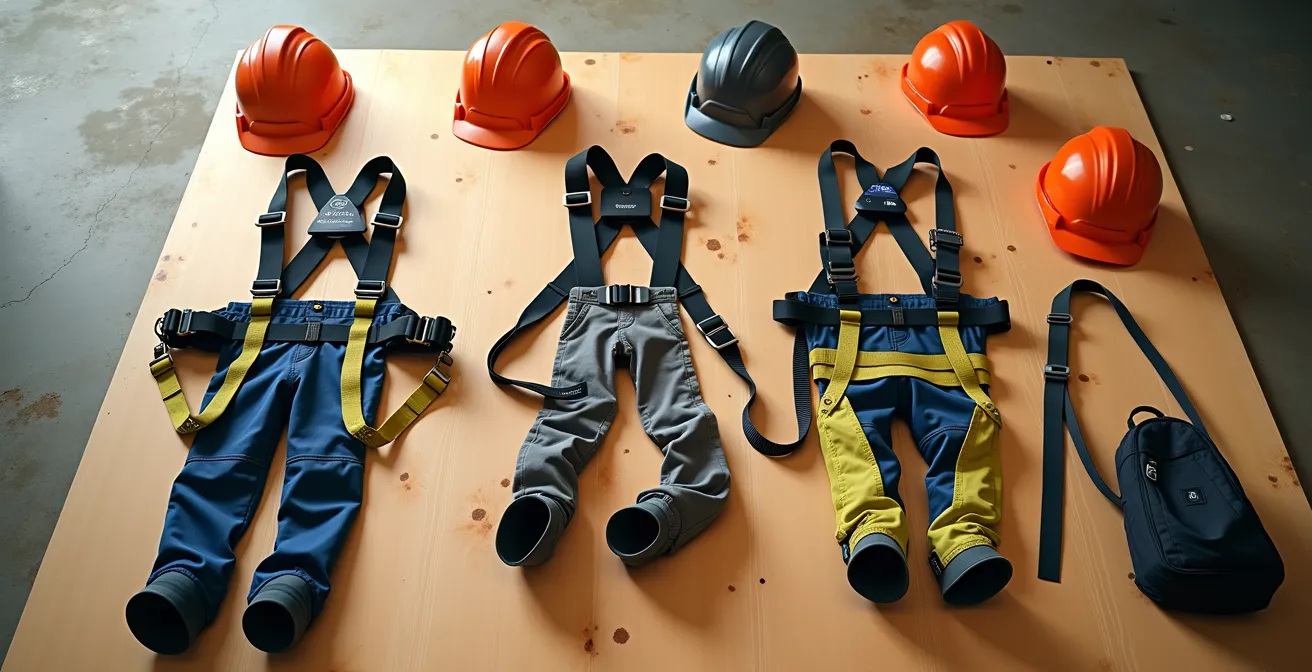
- Inspect harness systems for wear patterns indicating stress points
- Check ladder stability mechanisms for deformation or loosening
- Verify anchor point integrity through load testing protocols
- Document equipment inspection dates and failure patterns
Temporal degradation patterns signal the third diagnostic category. Increasing error rates over time with the same crew using the same tools indicate wear that compromises precision below acceptable thresholds. This gradual decline often escapes notice because each individual project shows only marginal quality reduction, but the cumulative trend reveals tool replacement needs.
| Tool Category | Early Warning Signs | Critical Failure Point |
|---|---|---|
| Fall Protection | Fraying, discoloration | Load bearing capacity loss |
| Power Tools | Inconsistent operation | Complete malfunction |
| Ladders/Scaffolds | Joint loosening | Structural collapse risk |
The diagnostic framework enables contractors to target interventions precisely. Rather than wholesale equipment replacement or extensive retraining programs, they can identify specific tools requiring upgrade and specific techniques needing refinement. This precision conserves capital while addressing the actual performance constraints. For complex projects requiring multiple specialties, contractors who master these diagnostic capabilities position themselves to hire a professional team capable of executing to the highest standards.
How Risk-Mapping Transforms Tool Investment Into Cost Prevention
Strategic tool investment requires frameworks that prioritize equipment upgrades based on failure consequence analysis rather than purchase price considerations alone. The most expensive tool doesn’t necessarily deliver the highest risk reduction, and the cheapest adequate option may prevent catastrophic losses worth multiples of the cost differential.
Risk mapping begins with failure mode analysis. Contractors identify which tool inadequacies produce the highest-consequence errors in their specific project types. Fall protection equipment failures create safety incidents with legal, financial, and human costs that dwarf the expense of premium systems. Measurement tool inaccuracies generate material waste and timeline delays but rarely threaten life or create liability exposure at the same magnitude.
The human cost dimension deserves particular attention. Research reveals that employers lose thousands annually per affected worker, with substance disorder cases generating $8,591 in annual losses through productivity reduction, medical expenses, and elevated injury risk. Tool investments that reduce physical strain or cognitive load contribute to safer work environments that minimize these compounding personnel costs.
Expected value calculation provides the quantification framework. Contractors estimate the probability of tool-driven error, multiply by average cost of that error type, then factor in prevention effectiveness of quality upgrades. This formula reveals true ROI that conventional cost-benefit analyses miss.
A measurement system that costs $800 more than basic alternatives might prevent material waste averaging $3,000 per year across a contractor’s project volume. If the probability of measurement-driven errors drops from 15% to 3% with the upgrade, the expected annual savings reach $2,760, delivering full payback in under four months while continuing to generate returns for years.
| Equipment Type | Failure Risk | Investment Priority |
|---|---|---|
| Fall Protection Systems | Catastrophic | Immediate |
| Measurement Tools | Moderate | Planned |
| Hand Tools | Low | Routine Replacement |
Phased investment strategy emerges from this prioritization framework. Contractors focus initial capital on tools where quality gaps produce catastrophic failures, then systematically address moderate-risk categories as cash flow permits. This approach maximizes near-term risk reduction while building toward comprehensive equipment optimization.
The framework transforms tool purchasing from reactive replacement to strategic prevention. Rather than buying equipment when failures force the decision, contractors anticipate upgrade needs based on failure consequence analysis. This proactive stance prevents the cascading costs, client relationship damage, and safety incidents that reactive approaches allow to develop.
Quality roofing tools function as comprehensive risk-prevention instruments rather than simple implements. The mechanisms revealed through cascade analysis, cost multiplier examination, and diagnostic pattern recognition demonstrate that tool investment decisions ripple through every dimension of contractor profitability and sustainability. By applying the risk-mapping framework, contractors shift from defensive cost minimization to strategic value protection, transforming equipment budgets from necessary expenses into high-return prevention investments.
Key Takeaways
- Single tool failures trigger sequential project disruptions that compress timelines and force safety-compromising rushed work
- Hidden costs from equipment inadequacy exceed visible material waste through permit extensions and lost opportunity windows
- Equipment quality signals professionalism to clients, directly influencing referral velocity and lifetime relationship value
- Diagnostic patterns distinguish tool-caused errors from skill gaps, enabling precise intervention rather than wasteful misattribution
- Risk-mapping frameworks prioritize tool investments by expected value of error prevention rather than purchase price alone
Frequently Asked Questions on Roofing Safety
What percentage of workplace deaths occur in construction?
Construction accounts for approximately 20% of all workplace fatalities despite representing only 7.5% of employment. This disproportionate risk underscores the critical importance of safety equipment investment and proper tool maintenance protocols that prevent the conditions leading to fatal incidents.
Which safety violations are most commonly cited?
Fall protection requirements, hazard communication, and ladder safety consistently rank in OSHA’s top violations. These categories directly correlate with equipment quality decisions, as inadequate fall protection systems, poorly maintained ladders, and insufficient safety communication tools create the conditions that lead to citations and incidents.
How do quality tools reduce insurance costs over time?
Premium tools reduce insurance costs through multiple channels: fewer worker injury claims from equipment-related incidents, lower liability exposure from quality defects, and improved safety records that qualify contractors for better premium rates. Many insurers offer discounts for documented safety equipment programs and preventive maintenance protocols.